


ABC and XYZ analysis in Torgsoft: optimizing the assortment by sales volume and stability

Torgsoft provides extensive analytical tools. Among them are ABC and XYZ analysis. This is a simple yet effective and visual method. It allows analyzing the assortment and determining, based on the volume and stability of sales, which products should always be in sufficient quantity, and which, on the contrary, can be removed from the assortment.
ABC analysis
ABC analysis is a method of studying the assortment. It is based on the Pareto principle — 20% of goods generate 80% of efficiency, while the remaining 80% of goods account for only 20%.
With this analysis, you can determine each product's contribution to the store's profit and categorize goods for effective management.
Three categories of goods are distinguished:
- Category A — priority goods. 20% of the goods that generate 80% of the profit. Group A products ensure the company's main turnover. Therefore, they must always be in stock. A common practice is to create surplus stock for group A items.
- Category B — regular goods. Group B products make up 30% of the assortment and generate 15% of sales. They also support the company’s main turnover. They should always be available and sufficiently stocked in the warehouse or retail network.
- Category C — low-selling products that make up about 50% of the assortment and bring in ~5% of the profit.
Why is ABC analysis needed?
Applying ABC analysis reduces the time spent on managing and controlling the product assortment.
With ABC analysis, you can:
- Identify product groups that generate the highest profit;
- Optimize the assortment;
- Highlight goods that sell well or poorly;
- Manage product supply;
- Compare performance with the previous period.
How often should ABC analysis be conducted?
It is not recommended to perform ABC analysis too frequently, as the results may not be clear, for example, due to cyclical sales fluctuations by days of the week or seasons. The frequency depends on the product group. For instance, stores with seasonal sales can perform a full assortment analysis once every six months or a year to track changes compared to the previous period.
If you manage a grocery store with a relatively stable assortment, then conduct the analysis more often — once a month or even weekly.
It is important to note that category A products are always the fewest, while category C products are the most numerous. At the same time, category A products are the priority in terms of procurement and marketing. Category B products expand the assortment and should be available, while category C products, if not excluded, require less attention, and their absence in the store will not significantly affect its attractiveness for customers.
When conducting the analysis, pay attention to certain product groups:
- Promotional goods. If promotions were held during the analysis period, sales results may distort the ABC analysis. Exclude promotional goods from the analysis or adjust their results according to the promotion conditions.
- Premium goods. Products that sell rarely but bring significant revenue when sold. Including them in the ABC analysis will most likely place them in category C. However, they are important for the assortment and should not be excluded.
- New products may not be included in the analysis, as they likely have not yet gained sufficient popularity and will remain in the assortment only for the first few months of sales.
- Out-of-stock products. Goods may be temporarily unavailable for various reasons, but they could have sold well and been in demand. Therefore, when interpreting the ABC analysis, it is useful to know the date of the last arrival of such goods in the store.
How to conduct ABC analysis in Torgsoft
To conduct an ABC analysis, go to the menu item Analysis - ABC and XYZ analysis. The corresponding settings window will open.
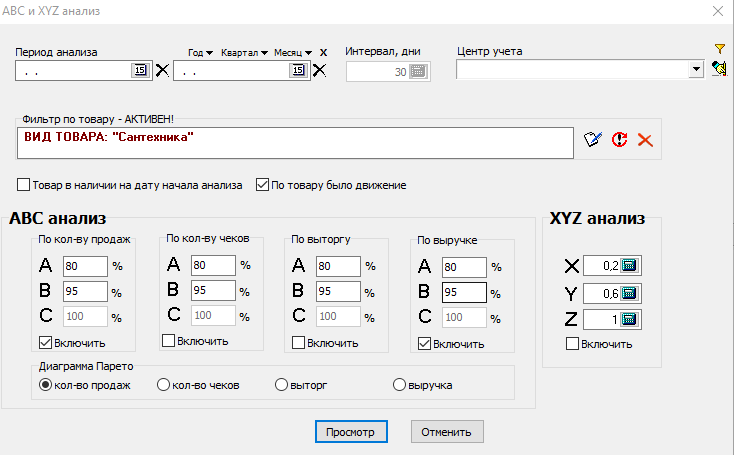
First, you need to set the Analysis period and, if necessary, the Accounting center.
Using the standard Product filter, select the group of goods for analysis.
If needed, specify the settings Product available at the start date of analysis and Product had movement during the selected period.
ABC analysis in Torgsoft can be conducted by the following criteria:
- By sales quantity. This criterion identifies products sold in the largest volume. These are the most essential and popular products for customers. They may not generate maximum profit, but without them the assortment will be incomplete.
- By number of receipts;
- By revenue;
- By proceeds.
For more accurate analysis, it is usually better to use several criteria. To include a criterion in the analysis, you need to activate the checkbox Include next to the relevant parameter.
Percentage ratio of categories
In Torgsoft, the optimal percentage ratio for ABC analysis is set as 80-95-100. If necessary, you can specify another ratio.
Below, select the criterion on which the Pareto chart will be built. It must be one of the criteria included in the analysis.
After completing the necessary settings, click the Preview button. A table of products divided into categories will appear.
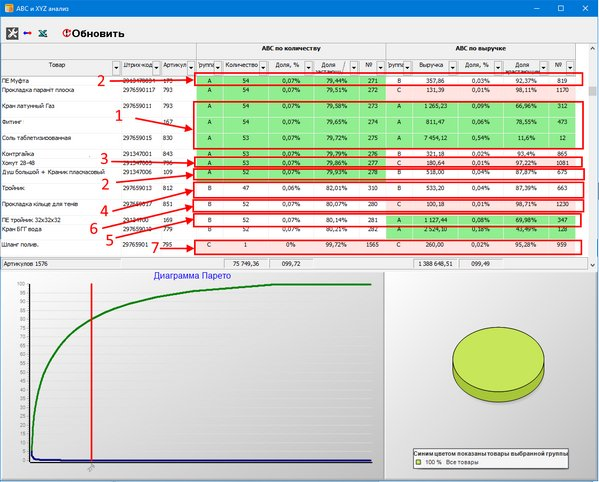
To obtain up-to-date revenue data, calculate the cost price.
As an example, let’s look at the results of analyzing goods by sales quantity and profit.
- Category AA (1) - the most valuable products. These items sell well and bring profit. Monitor their availability in the store. Cooperation with suppliers of such goods should be well established. Consider creating special conditions for such suppliers: providing extra shelf space, maintaining surplus stock, etc. Lack of these goods will significantly impact profit.
- Category AB (2) - products that sell well but generate moderate profit. Maintain stable availability of such items.
- Category AC (3) - high sales but low profit. These products are popular and attract customers. They should always be in stock despite the low margin.
- Category CA - low sales but high profit. These may be unique products or items with a high markup. Apply marketing strategies to increase sales of such products.
- Category BB (4) - products attractive to a specific audience but not very popular and generate average income. Control their stock levels without excessive reserves.
- Category BA (5) - products with average sales but high proceeds. Organize promotions for such items to boost sales.
- Category BC and CB (6) - average sales and low profit. Sales can be increased through upselling, motivating sellers to recommend these products, or enhancing their attractiveness (packaging, lighting, better display, bright price tags).
- Category CC (7) - all indicators are low. These products require close attention and detailed analysis of the reasons for weak performance. If after corrective actions there is no improvement, consider removing these low-performing goods from the assortment.
Note. Category C may include unique products that are only available in your store. Removing such products may lead to customer loss. Try to pay attention to them and invest in their promotion.
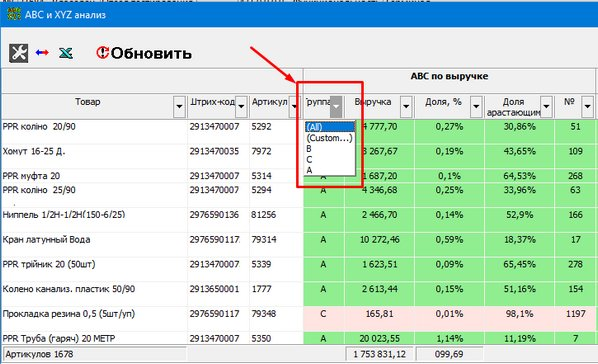
It is convenient to view the analysis using column filters. For example, filter the list of products by category A, B, or C.
XYZ Analysis
XYZ analysis shows the stability of product sales over a certain period.
The results of XYZ analysis allow you to divide products into categories, allocate storage space, organize stock levels, and manage delivery.
The basis of this analysis is the calculation of the coefficient of variation of the products. The essence of the coefficient of variation is to evaluate the percentage deviation of sales volume from the average value. The higher the variation coefficient, the less stable the sales volume of that product.
- Category X - products with the most stable sales volume (coefficient of variation up to 0.1–0.2).
- Category Y - products with predictable but variable sales volume (coefficient of variation from 0.2 to 0.6);
- Category Z - products with random demand (coefficient of variation from 0.6 and above).
In some cases, the coefficient of variation can be greater than 1 if product sales are unstable. For example, if a product was not sold for several months, and then 100 units were sold in one day.
When conducting XYZ analysis, remember the seasonality of sales for certain product categories. A simple example is ice cream, which sells well and steadily in hot weather but is unstable in cold periods.
Most often, XYZ analysis is carried out together with ABC analysis. Such a combined analysis allows you to see more accurately all the nuances of sales and the relevance of the assortment.
How to perform XYZ analysis in Torgsoft
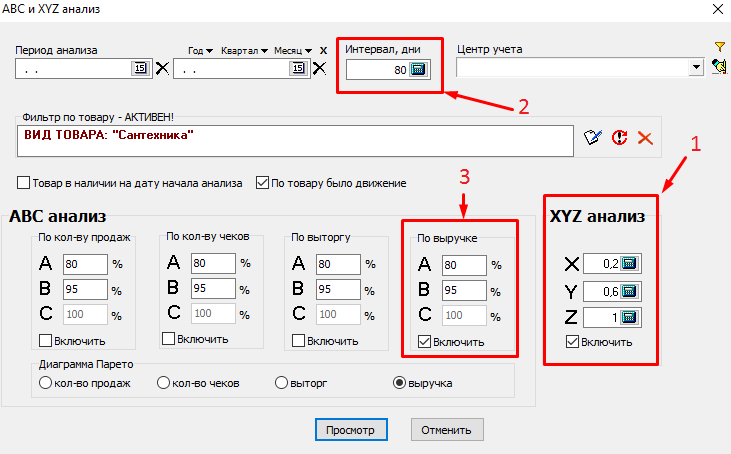
In the analysis settings, you need to check the box next to Enable XYZ analysis. In the Interval field, specify the number of days during which the product was sold.
Include the ABC analysis category in the analysis, for example, by revenue. Specify the period, the required product category, and click Preview.
A product table by categories will appear
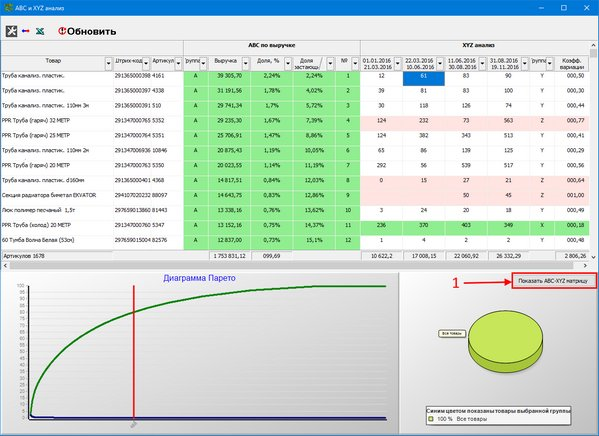
Torgsoft builds a category matrix based on the specified number of criteria. To display the matrix, click the Show ABC-XYZ Matrix button.
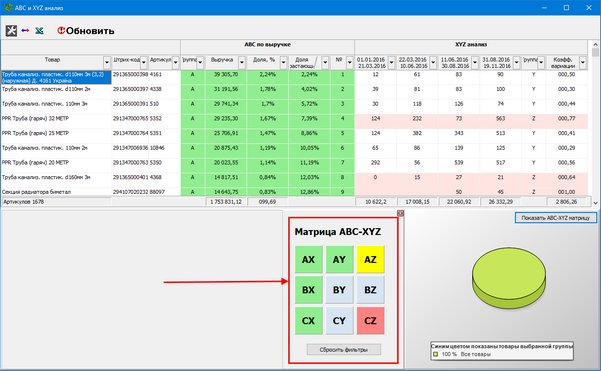
Green color indicates products that ensure the main turnover and are sold steadily. It is necessary to ensure constant availability of these products.
Yellow indicates a category that requires attention. These are important products but with unstable sales.
Red indicates a category that requires thoughtful analysis. These products can be removed from the assortment if they are not new, premium, or unique.
Let’s consider each category:
- Group AX. Products of group AX with high turnover and stable sales. These products should be available in the store or warehouse, but there is no need to create excessive stock. Sales of this group are stable and well predictable.
- Group BX. Products of group BX have characteristics similar to group AX. Control availability without excessive stock. Sales of this group are also stable and predictable.
- Group CX. Products of group CX are ordered from the supplier with stable regularity.
- Group AY. High turnover, unstable sales. Such products are better kept in small excess stock to avoid shortages in the store.
- Group BY. High turnover, unstable sales. Keep a small excess stock in the warehouse to ensure permanent availability of group BY products in the store.
- Group CY. Products of group CY can be ordered regularly from the supplier. At the same time, it is recommended to keep a safety stock due to demand fluctuations if financial possibilities allow.
- Groups AZ and BZ. Products of groups AZ and BZ, despite high turnover, have low predictability of sales. Attempting to ensure guaranteed availability only through excessive stock leads to a significant increase in average inventory. For these groups, review the ordering system. Some orders should be switched to a constant order volume system. Consider more frequent deliveries; selecting suppliers located near your warehouse; more frequent inventory control of groups AZ and BZ; assign the most experienced manager to work with these groups.
- Group CZ. Group CZ includes new products, products of spontaneous demand, and those supplied on order. Some of these products can be painlessly removed from the assortment. Others should be regularly monitored, since it is products from this group that generate illiquid stocks that cause company losses. Remove from the assortment leftover products ordered under request or discontinued items.
If you apply ABC and XYZ analyses to reduce assortment and eliminate positions, consider the following points:
- If you repeat the analysis immediately after reducing positions, new products will again appear that can be excluded from the assortment;
- If you abruptly and thoughtlessly dispose of all illiquid products relying only on numbers and ignoring product specifics, this may affect sales of other assortment products. Be guided by logic, production needs, and the ability to provide customer choice.