


Phrases that sell: how to communicate with customers to increase sales
.png "Phrases That Drive Sales")
Success in sales largely depends on the words and phrases you use when communicating with clients. We have compiled two lists for you:
-
the most used words and phrases that will help in sales,
-
expressions that sellers should avoid.
First, let’s define what rules should be included in your business communication policy.
Principles of Communication with Clients
✅ Length vs Content
Complex and lengthy sentences are incompatible with sales. To ensure your clients understand the information without extra effort, you need to explain in terms they understand and directly address the client's needs and pains.
Where is the balance point? ⚖️
Use simple sentences to avoid confusing the buyer.
1 sentence = 1 piece of information.
✅ Moderate Advertising
We often see overly emotional and direct advertising slogans in marketing messages, such as:
"Limited time offer! Buy now while stocks last!",
"Just for you! An exclusive offer that won't be repeated!",
"Incredible prices! Get the best deal, only here."
Such phrases no longer attract people; on the contrary, they repel clients and annoy with their blatant advertising content.
✅ Honesty
There is lying, and there is deception. Deception involves distorted facts and vague formulations that are not direct lies but are also not the truth, used to support weak and unproven claims.
"Our slimming bars will guaranteedly reduce your weight in just 1 month."
"Order our sun protection film for your car, and you will forget about heat and interior overheating in summer."
Your film is unlikely to make the client forget the problem, but it can help solve it and improve their quality of life.
Honestly describe the product’s features and the problems it helps solve for the client.
Also, provide complete information about the product: terms of use, return policies, delivery, and payment methods. If you state free delivery, it must be true. This helps you gain customer trust faster.
✅ Competence
Clients trust advertisements showing that the seller or company has long-term and serious expertise in the field. Share your expert opinion on the product in your marketing text or during client interactions.
Show how your company has achieved positive results, share client success stories, and their experience using your product on your website or social media. Ensure your communication is clear, as people are interested in your experience, not impersonal numbers and complex terms.
Example from a business school website in Ukraine:
"We provide our students with a comprehensive educational program using the most effective teaching methods that combine progressive thinking skills, professional events and modular courses deemed important by faculty and the community."
It is unclear what exactly the educational program includes, which professional events and teaching methods are used, creating a sense of complexity.
Example from another school:
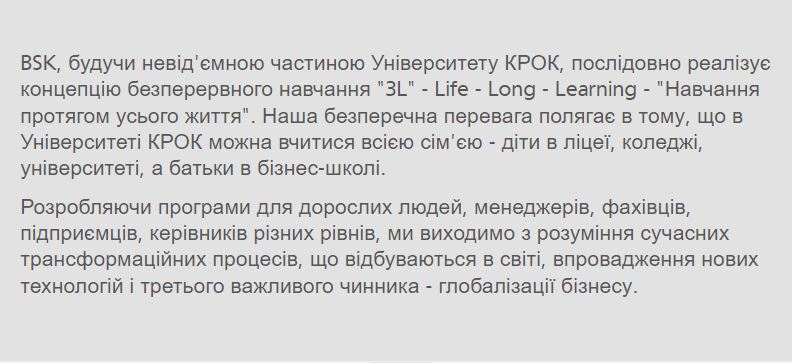
This better showcases the school's expertise and main benefits for all participants.
✅ Specificity
From the previous point, another important principle follows: texts that sell should contain specifics, not abstract words and ideas.
Use facts and figures in client communication where necessary. Don’t say: "Your income will grow significantly." Instead, say: "Your income will triple in 2 months" (if it is true).
Instead of "We have a wide range of cakes," say: "Our bakery offers 40 types of cakes."
✅ Value
Numbers, statistics, and honesty are good, but do not forget the main purpose of your message: to generate profit. Show the benefits of your offer and how your product can help solve the client's problems and improve their life.
Example of client-focused text:
"Our cosmetics help women reduce aging signs like wrinkles, dry skin, loss of elasticity and firmness. Thanks to natural ingredients like coenzyme Q10, collagen, elastin, ceramides, retinol, and vegetable and fruit extracts, your skin receives essential nutrients, stays moisturized all day, and you will feel energetic and refreshed."
✅ Call to Action
Use more active verbs in the present perfect tense:
"Try [product] for free under these conditions:__"
"Explore the capabilities of [product]: view our latest catalog..."
"Test our new [product] and receive__"
Phrases That Help Sales:
You can use the following sales-driving phrases in client communications to attract attention:
Words to Avoid in Sales
Any text can be ruined by bulky lexical or syntactic constructions:
❌ Bureaucratic Language
Bureaucratic language involves speech clichés that convey information concisely but without specific meaning, often used to fill the client's "airtime" with complex constructions to create an illusion of expertise.
Many sellers mistakenly believe that using complex words and an official tone will impress buyers.
It does not.
Content filled with clichés does not increase website traffic, and sellers using bureaucratic language do not motivate clients to buy.
For example:
"Based on the above, to inform, for the purpose of, in connection with..."
These phrases can easily be replaced with simpler, everyday words:
-
"Based on the above" – "So".
-
"To inform" – "Please note".
-
"For the purpose of" – "To".
-
"In connection with" – "Because".
❌ Stop Words
Stop words are words or phrases that can be removed from the text without losing meaning. They carry no semantic load and are considered "fluff". Removing them will not make the text more interesting or informative but will make it cleaner.
➖ Inserted constructions: honestly, as you know, essentially, so to speak, maybe, presumably, eventually, at the moment, roughly, quite fairly, frankly, by the way, in my opinion, firstly, secondly.
➖ Indefinite prepositions and adverbs: something, somehow, somewhere, approximately, near, etc.
➖ Intensifiers: very, absolutely, definitely, really, minimally, maximally, generally, only.
➖ Evaluative adjectives: significant, large, affordable, effective, successful, relevant, high-quality, premium, guaranteed, ideal, quality.
➖ Verbal nouns: to carry out activities, to conduct repairs.
➖ Passive constructions: "the product will be delivered..." instead of "the courier will deliver the product...".
➖ Common phrases and advertising clichés: expanded sales geography, top three leaders, wide range, individual approach, flexible pricing policy, etc.
Words That Harm Sales
Content Is More Important Than Words
- There are no "right" or "wrong" words, but some words obscure meaning, carry no content, and mislead clients.
- Tell the truth, even if it is inconvenient – honesty is valued by clients.
- Have a few facts or proofs ready for each product or service to explain its usefulness and relevance.
- Tell stories and give examples – this sells best.
- Speak or write briefly with a focus on the product's benefits for the client.
- Write and speak as if for yourself.