


10 largest online retail platforms in Ukraine
Marketplaces give a store access to an established audience, payment, delivery and advertising tools, and the trust associated with a well-known platform. For a seller, this is a separate sales channel with its own rules, commissions, product listing requirements, and service performance indicators.
Below are ten Ukrainian online platforms where businesses can sell products. The numbering is used only for structure: this is not a ranking. Terms, fees, and available categories change, so before connecting, it is worth checking the current rules on the seller page of the specific platform.
What to consider before entering a marketplace
- Up-to-date stock levels and prices. Marketplaces take cancellations, stock errors, and price discrepancies into account. If a store sells simultaneously offline, on its website, and on several platforms, stock levels should be updated from a single inventory database.
- Product listing quality. Complete specifications, a correct name, photos, description, SKU, and barcode affect moderation, search within the catalog, and the number of questions from buyers.
- Order processing speed. A seller's rating depends on completed and canceled orders, dispatch times, reviews, and other service indicators.
- Logistics. Platforms are developing their own pickup points, parcel lockers, partner delivery services, and fulfillment. Before starting, it is worth calculating the costs of delivery, packaging, returns, and storage.
- Promotion within the platform. In many categories, organic placement is not enough. Commission, advertising, acquiring, and logistics should be included in the sales economics from the outset.
- Automation. With a large assortment, manually updating products, prices, and stock levels quickly creates discrepancies. XML, API, and ready-made integrations become part of the seller's daily work.
Tip from Torgsoft: make Torgsoft the primary inventory database for products, prices, stock levels, and sales. This makes it easier to control several sales channels and avoid selling a product that has already sold out in the offline store or on another platform.
1. Rozetka

What you should know:
- Rozetka combines its own retail business with a marketplace for third-party sellers across a wide range of product categories.
- The seller works through a separate account. Price lists, Pricecreator, and API are available for bulk product management.
- The platform supports product advertising, delivery through a network of pickup points, and fulfillment.
- Complete specifications, photos, correct availability status, and timely price updates are important for product listings.
Terms of cooperation: the seller goes through registration and moderation and pays commission and other fees according to the platform's current terms. The amount of expenses depends on the category, services, and operating model.
Tip from Torgsoft: for regular sales on Rozetka, use the «Integration with Rozetka.ua» option. It synchronizes products, prices, specifications, descriptions, images, and stock levels, while marketplace orders are transferred to Torgsoft as invoices. This eliminates the need to maintain the same catalog manually in two systems.
2. Prom.ua

What you should know:
- Prom.ua is a universal marketplace for retail and wholesale sales across many product categories.
- A seller can simultaneously operate in the Prom catalog, in the customer app, and on their own website created on the platform.
- For large catalogs, bulk import, integrations with inventory systems, and order management tools are available.
- Product promotion within the catalog operates under different advertising modes, while commission depends on the category and selected mode.
- Built-in payment and delivery scenarios are available.
Terms of cooperation: sales require a paid placement package. Commission on completed orders and promotion costs are charged separately depending on the category and seller settings.
Tip from Torgsoft: the «Integration with Prom.ua» option synchronizes products, prices, stock levels, and orders between Torgsoft and Prom. When an item goes out of stock in the inventory system, its availability is updated on the marketplace. This is especially important when one warehouse serves an offline store, a website, and Prom.
3. OLX

What you should know:
- OLX operates as a classifieds platform with separate tools for private sellers and businesses.
- Companies can use listing packages, a business page, and tools for promoting listings.
- OLX Delivery allows transactions to be processed through the platform and works with postal operators. Business payment scenarios are available for individual entrepreneurs and legal entities.
- The seller's rating and transaction history influence buyer trust, so up-to-date availability, quick responses, and accurate product descriptions are important.
Terms of cooperation: the number of free listings and the cost of packages depend on the category. For active sales, businesses usually use paid packages and separate promotion tools.
Tip from Torgsoft: after confirming an order, immediately reserve or process the product in Torgsoft so that it does not remain available in other channels. For regular shipments, you can use the «Integration with Nova Poshta» and «Integration with Ukrposhta» options: consignment notes, labels, and shipment statuses are managed from the inventory software.
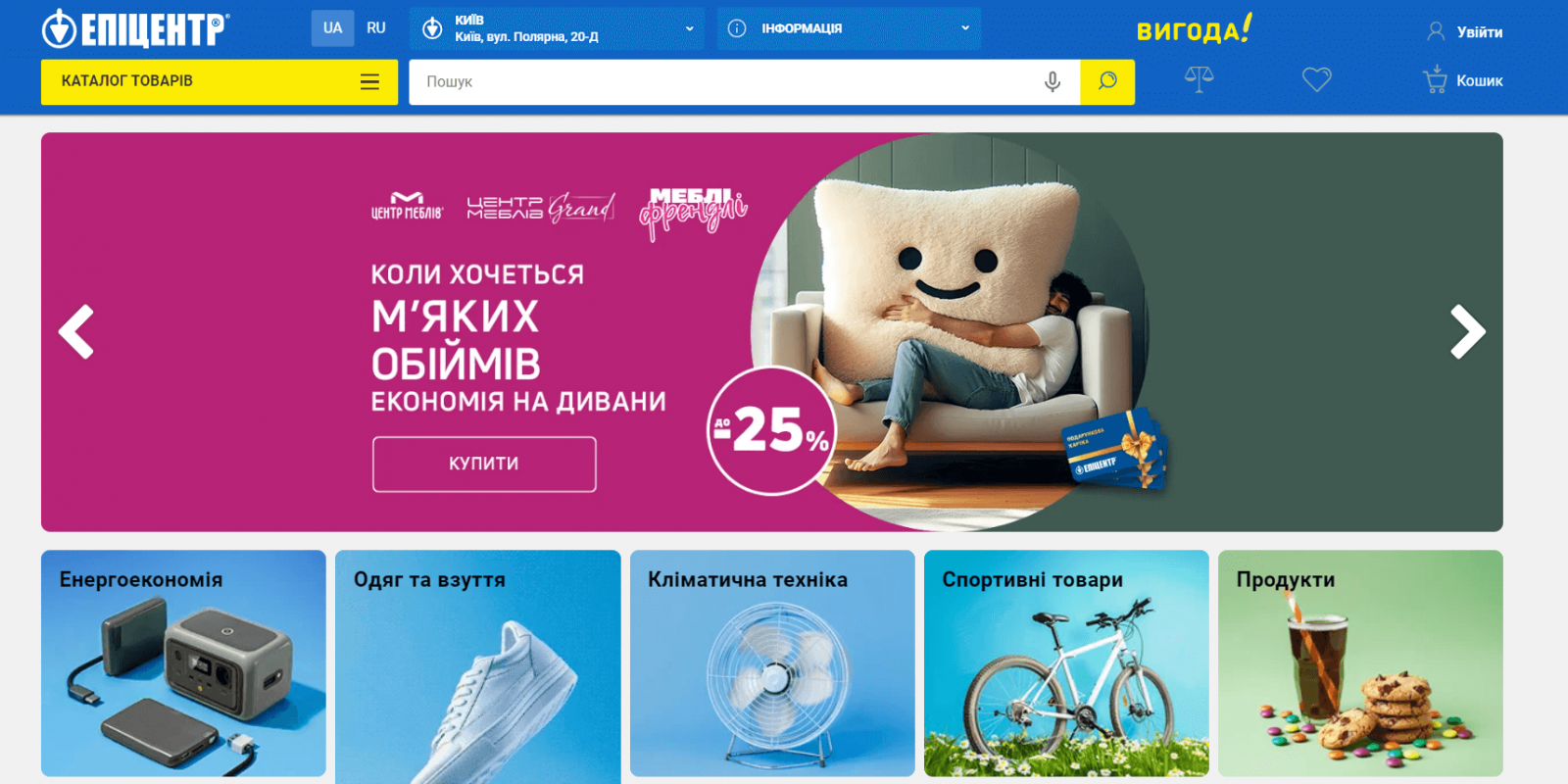
4. Епіцентр
What you should know:
- Epicentr combines its own online retail business with a marketplace offering a broad catalog of products for the home, renovation, appliances, sports, household use, and other categories.
- Sellers have access to an account, an API for working with orders, a mobile app, advertising, and integrations with financial and postal services.
- Orders can be collected through Epicentr pickup centers and parcel lockers.
- A product's position in search results is influenced by successful sales, price competitiveness, cancellation rate, reviews, and connected services.
Terms of cooperation: registered entrepreneurs and legal entities can work with the platform. A contract and configured payment and delivery methods are required. The marketplace charges a fee for using the account and a commission on completed orders; specific terms depend on the category.
Tip from Torgsoft: if the platform rating depends on cancellations, it is especially important not to display products that are not actually in stock. In Torgsoft, use product reservation, minimum stock levels, and warehouse control so you can see the actual availability of an item before confirming an order.
5. Bigl.ua

What you should know:
- Bigl.ua is part of the Prom.ua ecosystem and displays products from sellers who work through Prom and meet the platform's requirements.
- Bigl has no separate seller account: products and orders are managed through the Prom.ua account.
- Sellers are subject to requirements regarding service quality, product relevance, content, and handling reviews.
- Promotion uses tools from the Prom ecosystem.
Terms of cooperation: the seller first connects to Prom.ua and works under its commercial terms. Placement on Bigl depends on the seller's status, service quality, and compliance of the content with the platform's rules.
Tip from Torgsoft: do not create a separate manual catalog just for Bigl. Maintain products in Torgsoft and use «Integration with Prom.ua» to synchronize the Prom catalog. Bigl receives seller data through the Prom ecosystem, so keeping the main catalog in order simplifies work with both platforms at once.
6. Алло

What you should know:
- Allo combines its own retail business with a partner marketplace. Its assortment extends beyond electronics and covers many product categories.
- Sellers are verified as partners and work through a personal account.
- API integration, online payment, installment payments, and delivery to Allo pickup points are available.
- The platform monitors the relevance of prices and availability, product listing quality, and completeness of specifications.
Terms of cooperation: official status as an entrepreneur or legal entity, a contract, and moderation are required. Costs consist of the fee for access to the account and remuneration for completed orders; the commission rate depends on the connection terms.
Tip from Torgsoft: establish a rule: price and stock changes are first entered into the inventory system and then transferred to the marketplace. In Torgsoft, you can restrict employees' rights to change prices and monitor the history of actions so that data across sales channels does not diverge because of accidental editing.
7. F.ua

What you should know:
- F.ua operates as an online store and marketplace: the catalog contains products from the retailer itself and from third-party sellers.
- The marketplace has an API for working with categories, products, orders, statuses, and delivery data.
- Accurate product specifications, SKU, price, and timely order status updates play an important role.
- The seller receives connection terms and commercial parameters while working with the platform.
Terms of cooperation: before connecting, it is worth separately clarifying the availability of the required category, content requirements, commission, logistics, and catalog upload format.
Tip from Torgsoft: use a stable product SKU as a common identifier in Torgsoft and the external account. For an assortment with many similar models, this reduces the risk of confusing items when updating prices, stock levels, or processing orders.
8. Kasta

What you should know:
- Kasta has a strong focus on clothing, footwear, accessories, and home goods and works with a large number of brands and third-party sellers.
- Two main models are available: the seller processes, packs, and ships orders independently, or transfers products to Kasta fulfillment.
- Under the fulfillment model, Kasta takes care of warehouse operations, communication with the buyer, shipping, and returns.
- Commission and logistics costs depend on the category and cooperation model.
Terms of cooperation: the seller registers, activates a profile, configures the account, and uploads content. Before starting, it is necessary to compare the economics of independent order fulfillment and fulfillment services.
Tip from Torgsoft: for clothing and footwear, maintain size range, color, season, and photos in the product card. If part of the assortment is transferred to fulfillment, account for it separately from products in your own warehouse so you can see actual stock levels by storage location.
9. Zakupka

What you should know:
- Zakupka focuses on B2B sales and catalogs of products and services for businesses, although the platform also includes broader product categories.
- Sellers can create a catalog and their own website on the platform, manage products in bulk, and import and export items.
- SEO tools, promotions, integrations with delivery and payment services, as well as connections to third-party services via API, are available.
- For wholesale sellers, complete specifications, units of measurement, documents, up-to-date prices, and supply terms are important.
Terms of cooperation: available features depend on the selected tariff and required tools. Before connecting, it is worth checking catalog limitations, product import, available integrations, and promotion terms.
Tip from Torgsoft: for B2B sales, use sales with invoice issuance, invoices, delivery notes, payment control, and a wholesale pricing policy. For regular wholesale customers, you can enable the «Electronic Catalog for Ordering Products» so that they can see current prices and stock levels and place orders without involving a manager.
10. Shafa.ua

What you should know:
- Shafa has a strong focus on clothing, footwear, accessories, beauty products, and home goods. Both new and used products are sold on the platform.
- The platform charges a commission on successful sales. Its amount depends on the product category and price.
- Paid listing promotion tools are available for additional visibility.
- For the seller, the quality of the description, real photos, correct category, order processing speed, and service quality are important.
Terms of cooperation: before listing, it is necessary to check the rules of the specific category, the current commission, product requirements, and available promotion methods.
Tip from Torgsoft: for clothing, footwear, second-hand goods, and unique items, maintain an accurate stock level for each model, size, and color and store photos in the product card. The Torgsoft mobile app allows you to check stock levels, conduct inventory counts, and photograph products near their storage location.
How to choose a platform for your store
First, check whether the platform has your category and the audience you need. Then calculate the full cost of a sale: commission, subscription fee or package, advertising, acquiring, delivery, packaging, returns, and order processing costs. Separately assess requirements for dispatch speed, seller rating, content, and stock levels.
For a store with several sales channels, it is important to have a single source of data about products and stock levels. Torgsoft provides direct integrations with Prom.ua and Rozetka.ua, synchronization with an online store, integrations with Nova Poshta and Ukrposhta, a mobile app, product reservation, and inventory management tools.
Tip from Torgsoft: start with one or two platforms and measure the results separately for each channel: sales, margin after commissions and advertising, cancellation rate, returns, and processing time. Once the process becomes manageable, connect the next channel to the same inventory system.